)

Renting vs Buying Property in Malaysia: What Makes Sense in 2026?
Key Takeaways
- Flexibility vs Stability: Renting offers mobility while buying provides long-term security.
- Cost Differences: Renting has lower upfront costs, while buying builds equity over time.
- Hybrid Strategy: Many Malaysians are combining renting and property investment.
- Market Shifts: Changing work patterns and economic uncertainty influence decisions.
- Personal Fit Matters: The right choice depends on financial readiness and lifestyle goals.
Why This Debate Matters More Than Ever
In 2026, Malaysians are facing a different economic reality than even a few years ago, with strong and often conflicting opinions on whether renting or buying makes more sense in uncertain conditions1.
Some still view property ownership as a reliable way to build wealth, while others prioritize flexibility due to shifting job markets and rising living costs. Remote work, delayed financial commitments, and the growing perception of property as both a home and an investment are reshaping how Malaysians approach housing decisions.
These changes highlight a major shift: people are no longer choosing between renting and buying purely for lifestyle—they are also thinking strategically about returns and long-term positioning2.
The Investment Angle: Buying to Rent
A growing trend in Malaysia is buying property specifically to rent it out immediately, turning homeownership into an income-generating strategy rather than just a living arrangement3.
This has led many to rethink the traditional question. Instead of choosing one or the other, some are renting their own homes while owning investment properties elsewhere, balancing lifestyle flexibility with asset growth.
While attractive, this approach comes with risks such as vacancy periods, maintenance costs, and market fluctuations, making careful financial planning essential rather than optional.
Renting: Freedom, Flexibility, and Lower Commitment
For many Malaysians, renting offers a practical and flexible way to live, especially in times of economic uncertainty where mobility is valuable4.
Renting allows individuals to avoid large upfront costs, relocate easily, and live in prime areas without the financial burden of ownership. It also removes the responsibility of maintenance, which is typically handled by landlords.
However, renting comes with trade-offs. There is no asset accumulation, rent may increase over time, and tenants have limited control over their living space.
Buying: Stability, Ownership, and Long-Term Value
Buying property in Malaysia is often associated with financial stability and long-term security, making it a preferred option for those with steady income and clear future plans5.
Homeownership allows individuals to build equity, customize their living space, and potentially generate rental income. Over time, property can also appreciate in value, contributing to wealth accumulation.
Despite these advantages, buying requires significant upfront costs and long-term commitments, which can be challenging for younger professionals or those with uncertain career paths6.
The Real Math Behind Renting vs Buying
Financial comparisons between renting and buying often reveal that renting can be more cost-effective in the short to medium term, particularly when factoring in upfront costs and interest payments7.
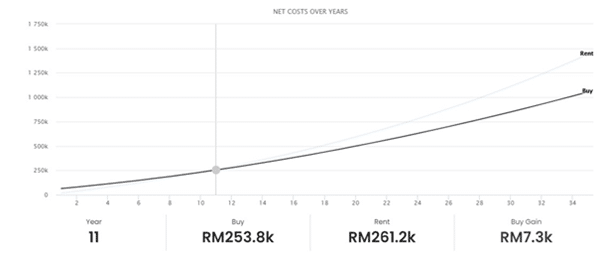
Comparison of long-term cost trends and equity growth between renting and owning property
Over a longer time horizon, however, buying can outperform renting as equity builds and property values increase. The key factor is duration—those who stay longer in one property tend to benefit more from ownership.
A Smarter Way to Decide: The 5-Question Framework
A structured approach can help simplify the decision-making process by focusing on financial readiness and long-term goals rather than trends alone8.
- Can you afford the upfront costs?
- Is your income stable?
- How long do you plan to stay?
- Are you ready for maintenance responsibilities?
- What are your long-term financial goals?
Answering these questions honestly often leads to a clearer and more personalized decision.
Lifestyle vs Financial Logic
The decision between renting and buying is not purely financial—it also reflects lifestyle preferences, priorities, and personal circumstances9.
- Renting suits those who value flexibility and mobility
- Buying suits those seeking stability and long-term roots
Neither option is inherently better; each aligns with different life stages and priorities.
What About Foreign Buyers and Global Trends?
Malaysia’s property market is also influenced by global trends, with international interest contributing to demand due to relatively affordable prices and investment potential10.
This external demand can impact pricing and availability, making timing and location even more important for local buyers.
The Hidden Costs People Forget
Both renting and buying come with hidden costs that can significantly affect financial outcomes over time.
- Renting: increasing rent, moving expenses, deposits
- Buying: taxes, maintenance fees, renovations, long-term interest
Understanding these costs is essential to making an informed decision.
The Rise of the “Hybrid Strategy”
A growing number of Malaysians are adopting a hybrid approach—renting where they prefer to live while owning property in locations that offer better investment returns.
This strategy combines flexibility with asset building, but it requires disciplined financial planning and a clear understanding of market conditions.
So… Should You Rent or Buy in 2026?
The honest answer is that it depends on your financial situation, career stage, and long-term goals.
- Buying suits stable income and long-term plans
- Renting suits flexibility and lower financial pressure
- A hybrid approach suits those seeking both lifestyle and investment benefits
Final Thoughts: It’s Not a One-Time Decision
The decision between renting and buying is not permanent. As your life changes, your housing strategy should evolve too.
In 2026, making the right choice means aligning your finances, lifestyle, and future plans rather than following trends or assumptions.
Ultimately, the best decision is the one that works for your unique situation.
Frequently Asked Questions
Question: Is renting cheaper than buying in Malaysia?
Answer: Renting is generally cheaper in the short term due to lower upfront costs, but buying can be more beneficial over the long term as it builds equity.
Question: Can I rent and still invest in property?
Answer: Yes, many people adopt a hybrid strategy where they rent their residence while owning property elsewhere for investment purposes.
Question: How do I know if I’m ready to buy a house?
Answer: You should evaluate your financial stability, savings for upfront costs, long-term plans, and willingness to handle maintenance responsibilities.
Disclaimer: The information is provided for general information only. BridgeProperties makes no representations or warranties in relation to the information, including but not limited to any representation or warranty as to the fitness for any particular purpose of the information to the fullest extent permitted by law. While every effort has been made to ensure that the information provided in this article is accurate, reliable, and complete as of the time of writing, the information provided in this article should not be relied upon to make any financial, investment, real estate or legal decisions. Additionally, the information should not substitute advice from a trained professional who can take into account your personal facts and circumstances, and we accept no liability if you use the information to form decisions.
