)
.webp)
Home Improvement Market Malaysia: Trends, Growth, and Opportunities in 2026
Key Takeaways
- Strong Market Growth: Rising incomes and lifestyle changes are driving increased home improvement spending.
- Diverse Market Segments: The industry spans DIY tools, renovations, smart homes, and design upgrades.
- DIY Culture Expansion: More Malaysians are embracing hands-on home projects influenced by digital content.
- Property Market Link: Growth in real estate directly boosts demand for home improvement services.
- Digital Transformation: Online platforms and social media are reshaping how businesses reach customers.
A Market on the Rise
The Home Improvement Market Malaysia is having a major moment in 2026, evolving from simple repairs into a fast-growing sector driven by lifestyle upgrades and better living standards1.
This growth is supported by urbanization, a rising middle class, and a stronger focus on personalization, as demand expands across both small DIY projects and large-scale renovations2.
Consumers are also placing greater importance on aesthetics and functionality, reflecting a shift toward homes that combine comfort with visual appeal3.
The connection between property investments and home upgrades continues to strengthen as housing demand influences renovation activity across the country4.
What Counts as “Home Improvement” Today?
The definition of home improvement has expanded significantly, covering tools, renovation services, interior décor, smart home systems, and outdoor enhancements.
- Hardware and tools
- Renovation services
- Interior design and décor
- Smart home upgrades
- Outdoor and garden improvements
This diversity allows consumers at all budget levels to participate, from simple upgrades to premium redesign projects.
Visualizing the Market
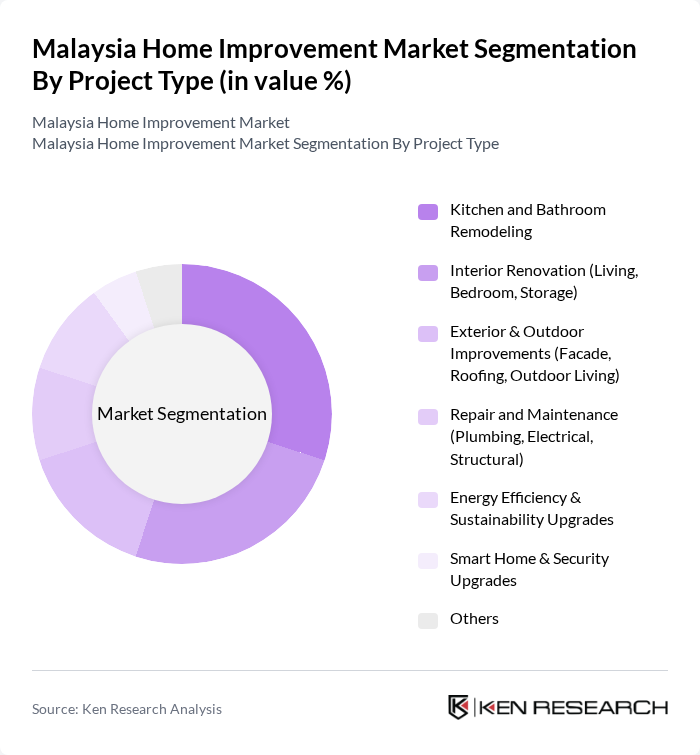
Segmentation of home improvement projects across different categories and consumer groups in Malaysia
The market structure reflects a wide range of customer needs, making it highly dynamic and adaptable to changing trends.
The Rise of the DIY Culture
DIY culture is rapidly gaining popularity in Malaysia, with homeowners increasingly taking on repairs and customization projects themselves, driven by cost savings and online inspiration.
Retailers are responding by offering affordable tools, kits, and guides, helping more consumers participate in hands-on home improvement activities5.
Mr. DIY: A Market Leader
Mr. DIY has emerged as a dominant force in the market by focusing on affordability, product variety, and accessibility across Malaysia6.
However, customer feedback highlights a balance between price and quality, with some users noting mixed experiences with product durability7.
Global Influence: Learning from the US and UK
Malaysia’s home improvement sector is influenced by global trends, where spending continues to rise and retail strategies evolve toward convenience and digital integration8.
Markets like the UK also emphasize omnichannel retail and product variety, shaping how Malaysian businesses adapt to consumer expectations9.
The Link Between Property and Home Improvement
The home improvement sector is closely tied to property development, with renovation demand increasing alongside new housing projects and construction activity10.
This relationship creates a connected ecosystem involving developers, contractors, and suppliers.
Key Industry Players Beyond Retail
Beyond retail brands, suppliers and material providers play a crucial role in supporting construction and renovation activities across the industry11.
These businesses ensure the availability of materials and infrastructure needed for large-scale development.
Digital Transformation in the Industry
Digitalization is transforming how companies operate, with increased use of social media, online catalogs, and virtual consultations to reach customers12.
This shift allows smaller businesses to compete more effectively by leveraging digital marketing strategies.
Changing Consumer Behavior
Modern Malaysian homeowners are more informed, design-focused, and willing to invest in personalized living spaces.
- Open-concept layouts
- Energy-efficient appliances
- Minimalist aesthetics
These evolving preferences are reshaping the products and services offered across the market.
Opportunities in the Market
The market offers strong growth potential through specialized services, eco-friendly solutions, e-commerce expansion, and affordable innovation.
Challenges to Watch
Despite its growth, the industry faces challenges such as price sensitivity, quality concerns, increasing competition, and supply chain disruptions.
The Future of Home Improvement in Malaysia
The market is expected to grow steadily through 2031, driven by urban expansion, rising incomes, and changing lifestyles.
Future trends will likely include greater customization, smart technology integration, and closer alignment with property development.
Final Thoughts
The Home Improvement Market Malaysia in 2026 reflects a broader shift in how people view their homes—not just as living spaces, but as expressions of lifestyle and identity.
With continued growth, innovation, and consumer demand, the industry is set to become even more dynamic in the years ahead.
Frequently Asked Questions
Question: What is driving the growth of the home improvement market in Malaysia?
Answer: Growth is driven by urbanization, rising incomes, changing lifestyles, and increased interest in personalized living spaces.
Question: Why is DIY becoming popular in Malaysia?
Answer: DIY is gaining traction due to cost savings, accessibility of tools, and inspiration from social media and online platforms.
Question: How is technology influencing home improvement trends?
Answer: Technology enables smart home upgrades, digital marketing, virtual consultations, and improved customer access to products and services.
Disclaimer: The information is provided for general information only. BridgeProperties makes no representations or warranties in relation to the information, including but not limited to any representation or warranty as to the fitness for any particular purpose of the information to the fullest extent permitted by law. While every effort has been made to ensure that the information provided in this article is accurate, reliable, and complete as of the time of writing, the information provided in this article should not be relied upon to make any financial, investment, real estate or legal decisions. Additionally, the information should not substitute advice from a trained professional who can take into account your personal facts and circumstances, and we accept no liability if you use the information to form decisions.
